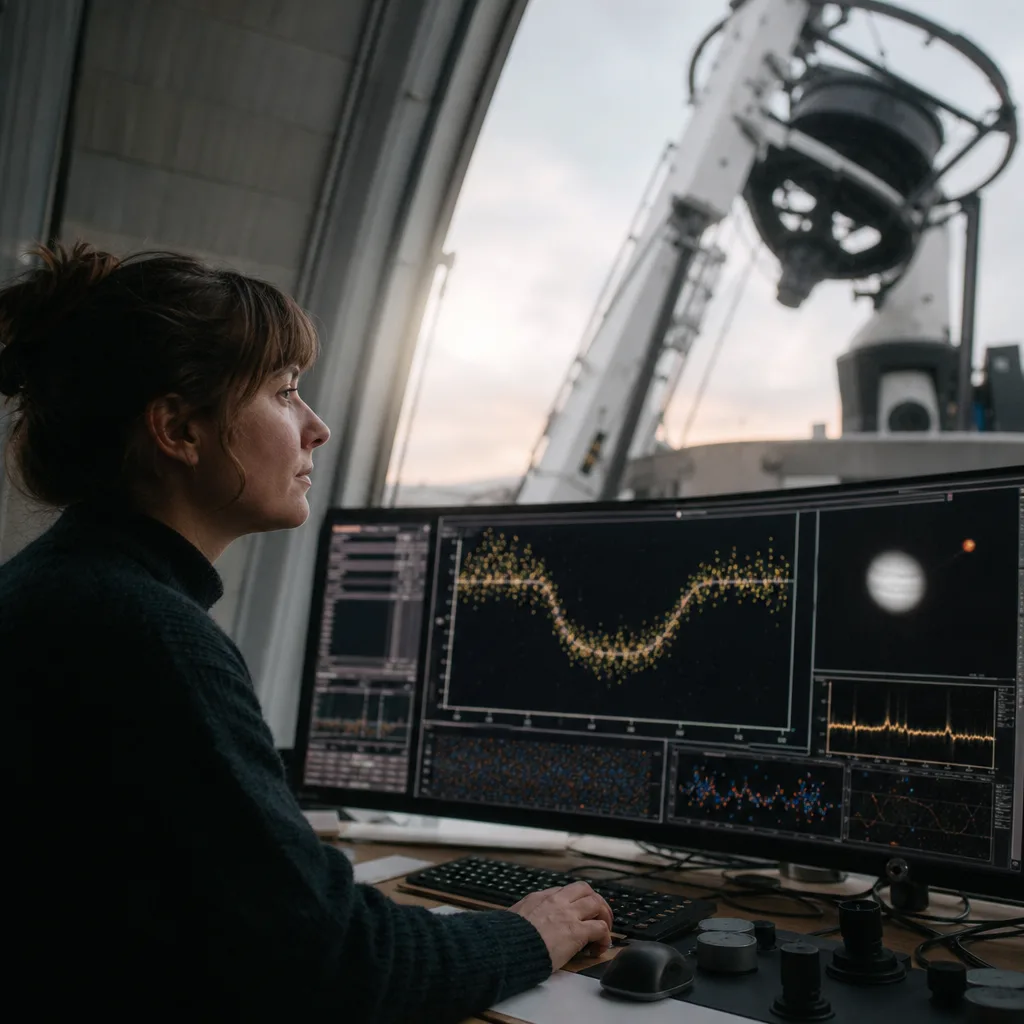
No scale in the universe is large enough. So how do astronomers put a number on the mass of a world billions of kilometers away?
It sounds like an impossible boast: to state the mass of a planet no human will ever visit, orbiting a star we see only as a point of light. And yet astronomers do it routinely, often to remarkable precision. The trick is that you never weigh the planet directly. You watch what it does to everything around it.
Gravity is the key, because gravity is mutual. A planet does not simply orbit its star while the star sits still; both bodies circle a shared center of mass, like two skaters spinning while holding hands. A heavier planet tugs harder, making the star trace a wider wobble. Measure the size and speed of that wobble and the planet mass falls right out of the equations.
For planets with moons, the method is even cleaner. The time a moon takes to complete one orbit, together with the width of that orbit, is fixed entirely by the mass of the world it circles. This is how we knew the mass of Jupiter long before any spacecraft arrived: we simply timed its moons through a telescope and let the mathematics do the weighing.
What makes this beautiful is how little it demands. No probe, no landing, no sample returned to a laboratory — only careful observation of motion, and a law of gravity that holds as firmly across the galaxy as it does in a falling apple. The same rule that drops a stone in your hand tells us the weight of worlds.
Replace this text with your own explainer: the measurement that amazed you, the clever indirect method behind a familiar number, and the question you would ask if a spacecraft could finally go and check. — Written by the editors.